
← All insightsFor sales managers and sales representativesArticle · 2023
The deal in the middle
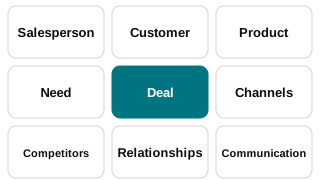
Many talk about putting the customer at the centre. The Business Map instead puts the deal itself in the middle. The salesperson provides a product, the customer has a need met and pays an agreed price. That is the core of every deal, and it should benefit both parties.
Around the deal are eight parts that together describe how it works. Which parties are doing the deal, businesses, consumers or public-sector customers, affects both the logic and the rules. That is why it is the first thing to look at.
Nine parts, nine questions
Each part of the map carries a question that is easy to ask and hard to answer carelessly.
- The deal. Which deal are we aiming for, and between which parties?
- The salesperson. Who sells at our company, and what is the balance between personal and digital selling?
- The customer. Which customers are profitable, which should we focus on, and who is the customer's customer?
- The product. What are we really selling, and which offerings match customers' changing needs?
- The need. Which needs and problems do we solve? The benefit must outweigh both the cost and the effort of buying.
- Channels. Do we sell directly or through others, and how do we choose between physical and digital channels?
- Competitors. Who is competing for the customer's money, including the customer choosing not to buy at all?
- Relationships. What relationship do we want with the customer, and what relationship does the customer want with us?
- Communication. Which message, to which target group, with which rhetoric?
How the map is used
The Business Map is made to gather around. Print it large, or put it up on a whiteboard, and go through the nine parts together with sales management and marketing leads. Start by agreeing on the current situation. Only when you agree on what the business actually looks like do you move on to what can be improved.
Then you choose a sales method with the help of META, the model for situational selling, and set the framework for sales targets, budget and which segments to work with which messages. The most important result is often that sales and marketing use the same message towards the customer.
How you can use it
Choose a deal or a segment and fill in the nine parts. Where you hesitate or give different answers, knowledge about the business is missing, and that is where the next step lies. The map works just as well for an individual sales representative's planning as for the executive team's annual review.
Source
Norval Institute, Affärskartan – analysera och utveckla affärer, article by Roberto Picornell and Anders Torelm, February 2023. The model is described in the book Försäljning – metoder, modeller och säljteknik (Sanoma, 2023).
The text is a summary of the article written for the web. The diagram is our own simplified rendering of the model's nine parts.