
← All insightsFor sales representatives and sales managersArticle · 2023
The customer gets a long way on their own
Someone who is going to buy something today rarely starts by calling a sales representative. The information is online, and by the time the customer makes contact, many potential suppliers have already been ruled out. The customer has also had time to form an opinion of both the seller and the product.
That makes every personal meeting more important, not less. When the chance of a real conversation comes, it must be made the most of, and often within a short time. The demands on the sales representative's professional skill increase as meetings become fewer.
Where the personal meeting makes a difference
Personal selling is at its strongest when several people need to be convinced, when the solution is complex and when the message needs to be adapted to the listener. The sales representative can explain, listen and adjust as the conversation goes on. The price is that it takes time and costs more per customer.
Digital channels have the opposite strengths. They scale, they are available around the clock and they are cost-effective when many customers need to be worked. For simple products in volume, the entire purchase can take place digitally. For most companies, the answer is therefore a hybrid, where digital channels handle the start of the customer journey and people take over when the deal becomes complex.
Three fields in balance
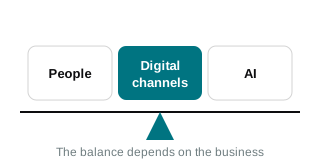
A simple way to look at it is three fields that need to be kept in balance. People own judgement, the relationship and the conversation. Digital channels own reach and availability. AI owns preparation, the patterns in what is already documented, the summary and the follow-up.
What the balance should look like depends on the business. The more complex the deal and the earlier the customer is in their buying process, the larger the human part becomes. The simpler the product and the closer the customer is to a buying decision, the more can be handled digitally.
AI as support, not a replacement
AI can give the sales representative better material before a meeting, remove administration and help spot patterns in customer conversations. But the effect does not come from the technology itself. Independent research shows that the same AI support can produce worse results when it does not fit how people actually work, and better results when the way of working, training and decision latitude are adapted to one another.
The conclusion is easy to state and hard to carry out: AI should be adapted to people and the way they work, not the other way round. That determines whether the support is used at all, and whether it makes any difference to the business.
How you can use it
Map out your own customer journey and mark each touchpoint: is it digital, personal or AI-supported today, and should it be? Then make sure sales and marketing use the same message in every channel. The biggest effect comes when the two work as one process, not two.
Source
Norval Institute, Hybridförsäljning och AI, article by Anders Torelm and Roberto Picornell, 2023. On AI and ways of working: Krakowski, S., Haftor, D., Luger, J., Pashkevich, N. and Raisch, S. (2026), Human-Centered Artificial Intelligence: A Field Experiment, Management Science 72(1), 57–72.
The text is an editorially updated version of the 2023 article. Market figures and predictions about AI from the original are not reproduced. Where the text refers to research, the source is given above.